ALBUM – View my Zambezia album
TRANSITION CHART – Mozambique Area
Fast Facts
Region: Southern Africa
Group: Mozambique Area
Classification: Colony, Portuguese
Prior Regime: Provinces of Tete and Quelimane / Mozambique Colony
Key Dates:
1498, Mar 1 – Vasco da Gama lands on Mozambique Island and “claims” the region of Portugal
1544 – Settlement at Quelimane founded
1752 – Colony of Moçambique, Zambesi and Sofala separated from Portuguese India in Goa
1892, May 20 – Zambezia Company concession created
1894 – Zambezia Province established by combining Tete and Quelimane
1920 – Tete was split from Zambezia to form two separate provinces
Following Regime: Quelimane and Tete Provinces / Mozambique Colony
Scott Catalogue: (Zambezia) #1-107, P1
Pick Catalogue: none
Currency: 1000 reis = 1 milreis, beginning 1912 100 centavos = 1 escudo
History
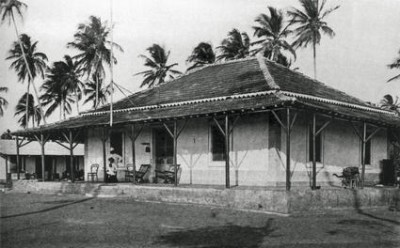
Until 1752, Portugal’s possessions on East Africa’s coast were administered by Portuguese India in Goa, but this changed when the region was placed under a Captain General who resided in the City of Mozambique. The Portuguese began to trade slaves (mainly destined to the French Mascarene islands, Mauritius and Reunion). With the loss of Brazil in 1822, and the slave trade being outlawed, Portugal began focusing more on its African possessions. Although the slavery was outlawed in Europe, the Portuguese continued a very lucrative slave trade with the Arabs and Ottomans until 1877.
During the Scramble for Africa in the 1880s, Portugal had to cede much of the territory it claimed in East Africa to Cecil Rhodes’ British South Africa Company and British East Africa Company, however Portugal’s claim over Mozambique was affirmed by the Berlin Conference of 1885. At this time, Mozambique’s infrastructure was developed with much assistance from the British, as both British Central Africa/Nyassaland and Northern Rhodesia both depended on railroads and roads connecting these areas with the ports of Beira and Mozambique.
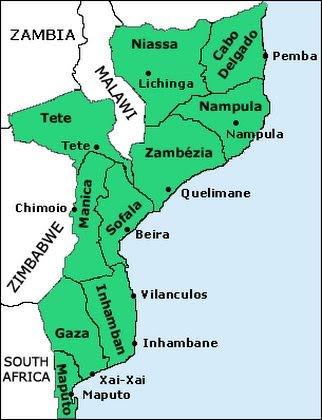 In 1891 the Portuguese shifted the administration of much of the country to large private companies which were granted control over mining, fishing, infrastructure, communications and taxing locals. The largest charters were given in 1891 to the Mozambique Company to administer the southern part of the country from Beira for 50 years and the British owned Nyassa Company for 35 years to control the territory north of the Lurio River. In 1892, the Zambezia Company was also established to administer the middle area of the country around the mouth of the Zambezi River. While the Zambezia Company was never officially chartered, it became the largest of the three.
The Province of Zambezia was established in 1894 by combining Tete, an inland territory, and Quelimane which became Zambezia’s capital city. During the life of this province, great upheaval was experienced in Portugal. On 5 Oct, 1910, a coup d’état was organized by the Portuguese Republican Party which ultimately deposed the constitutional monarchy and established a republican regime in Portugal. This can be seen in the stamps issued in the Province, as they were overprinted “REPUBLICA” beginning in 1911.
The Province of Zambezia (during this point in history) only lasted for 26 years, as Tete and Quelimane were again separated into individual Provinces in 1920.
Stamps
 ALBUM
ALBUM
During this time period, the colony of Mozambique was not yet centralized and communication between the various Portuguese outposts was difficult. Therefore, the individual provinces of Mozambique: Inhambane (1895-1914), Lourenço Marques (1895-1920), the city of Quelimane (1913-1922), Tete (1913-1914), and Zambezia (1894-1917) issued their own stamps, as did the Mozambique Company (1891-1942) and the Nyassa Company (1897-1929).
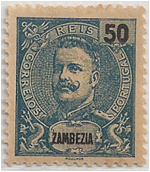
The first issues for Zambezia Province had 14 separate denominations depicting King Carlos of Portugal. In 1898, another set of King Carlos stamps were issued, using a standard Portuguese colonial design. The common design set featured a portrait of King Carlos, and printed the denomination in black in the upper right corner, and the colony name “ZAMBEZIA” in a tablet below the portrait.
In 1902 and 1905, stamps were surcharged to reflect new postal rates. A provisional issue also came out to reflect those changed rates.
After the Portuguese revolution in 1910, stamps were overprinted “REPUBLICA” and various stamps were issued and/or surcharged from 1911-1917.
The postal districts of Quelimane and Tete were created from parts of Zambezia in about 1913. When Tete was split off from Zambezia to form separate provinces in 1920, stamps of Zambezia, Tete and Quelimane were replaced by stamps of Moçambique Colony.
Banknotes
Portuguese currency was used in Zambezia
Links
History of Mozambique – Hubert de Vries heraldry
The British Ultimatium of 1890





6 Responses to Zambezia, Portuguese Colonial Province (1894 – 1920)